A good tradie website does three jobs: it tells a visitor what you do and where, gives them a quick way to call, and shows enough proof to win the job. Everything else is extra.
If you are comparing tradie website examples or using a tradie website template, these checks still apply. The best tradie websites are fast, clear and easy to trust, and that is what good tradie web design aims for.
Most tradie websites lose work on the same few points, and almost none of them are about looks.
1. The first screen answers what, where and how to contact you
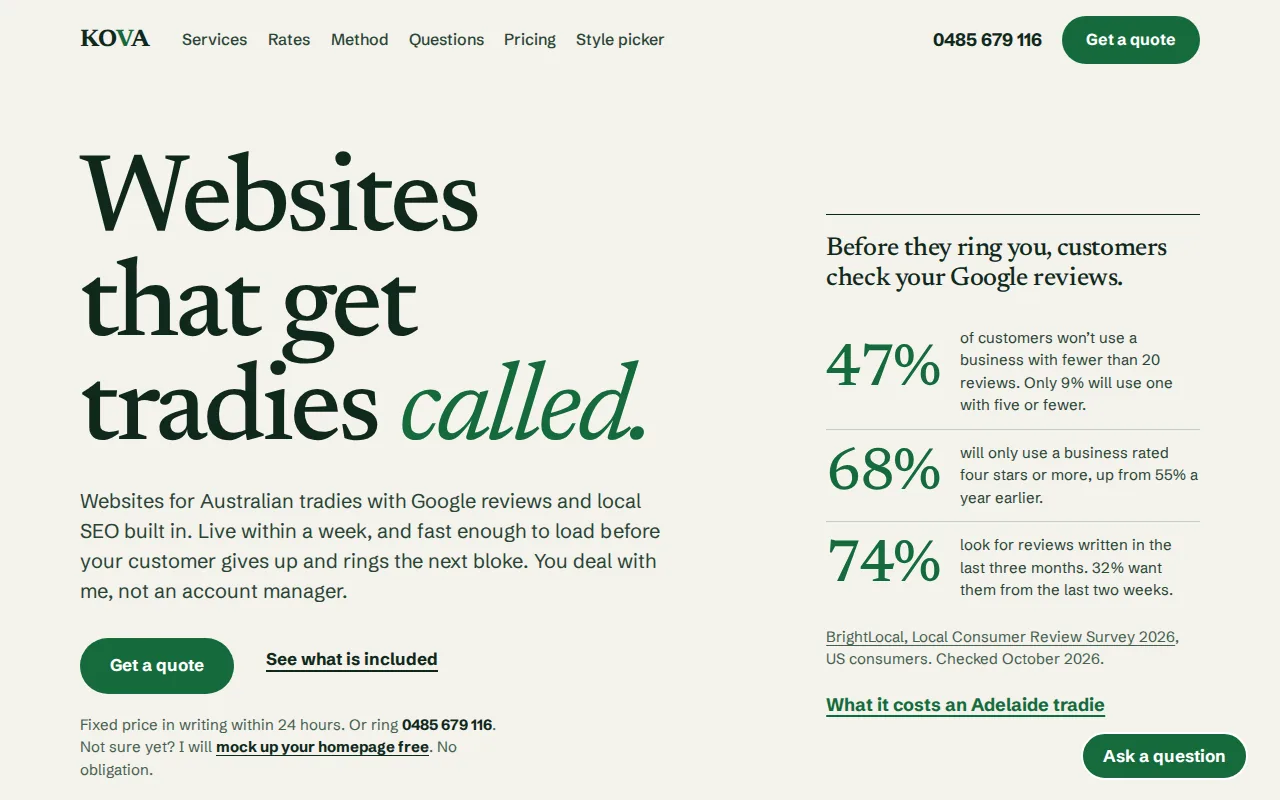
Most people land on a tradie site from Google on their phone. Often they are dealing with a leak, a spark or a crack, and they only give the page a few seconds. In that time, the first screen must tell them three things without scrolling:
- What you do, in the words they searched. Emergency plumber beats Quality Workmanship Since 2009.
- Where you work. A suburb or region in the heading shows you will actually come out.
- How to reach you. A phone number they can tap, and a quote button.
If your first screen is a striking photo of a sunset with your logo on it, the visitor has to work out whether you are the right person. Most will not bother. They will hit back and try the next result.
2. Your number works with one thumb
Tradies get most of their work by phone, so the number is the most important thing on the site. Make sure it is a real tap-to-call link on every page. Do not use an image of the number, and do not make people copy and paste it. On a phone, keep it within reach as they scroll: in the header or in a bar at the bottom of the screen.
Then test it from the site. I have seen tradie sites where the header number was an old mobile, or was missing a digit, for months. Nobody tells you. They just ring someone else. If you cannot always answer, missed call text back replies for you.
3. It loads fast on a phone, on site
Your customer is often on mobile data, standing in a hallway or a backyard. A site built from a heavy theme, with sliders, video backgrounds, and too many plugins, can be slow enough that they leave.
Speed also matters with Google. Its guidance says Google's core ranking systems look to reward content that provides a good page experience, and that Core Web Vitals, its measures of loading speed and stability, are used by its ranking systems. You can check yours for free at PageSpeed Insights. Look at the mobile result, not the desktop one.
4. One page for each job you want more of
A single Services page with a long list of everything you have ever done does not rank well, and it does not help people choose. A page for each main service does both. If someone is looking for switchboard upgrades, they want a page that explains what is involved in the upgrade and what can change the price, shows photos of past jobs and gives them an easy way to book.
Be choosy. Write pages for the jobs you want more of, not the jobs you already get too many of. If you would rather do renovations than call-outs, make the site lean that way. The service pages I use for electricians, plumbers, painters and landscapers show what that looks like in practice.
5. Your service areas are named, honestly
People search with a place in mind: concreter Morphett Vale, electrician near me. Your site should say plainly which suburbs and regions you cover, ideally on the home page and the contact page.
What does not work any more is thirty copies of the same page with the suburb name swapped. Google treats near-identical pages as low value and tends to filter them out. A handful of suburb pages that each say something real, like the jobs you have done there or how far you travel, will do more than thirty clones.
6. Photos of your own work
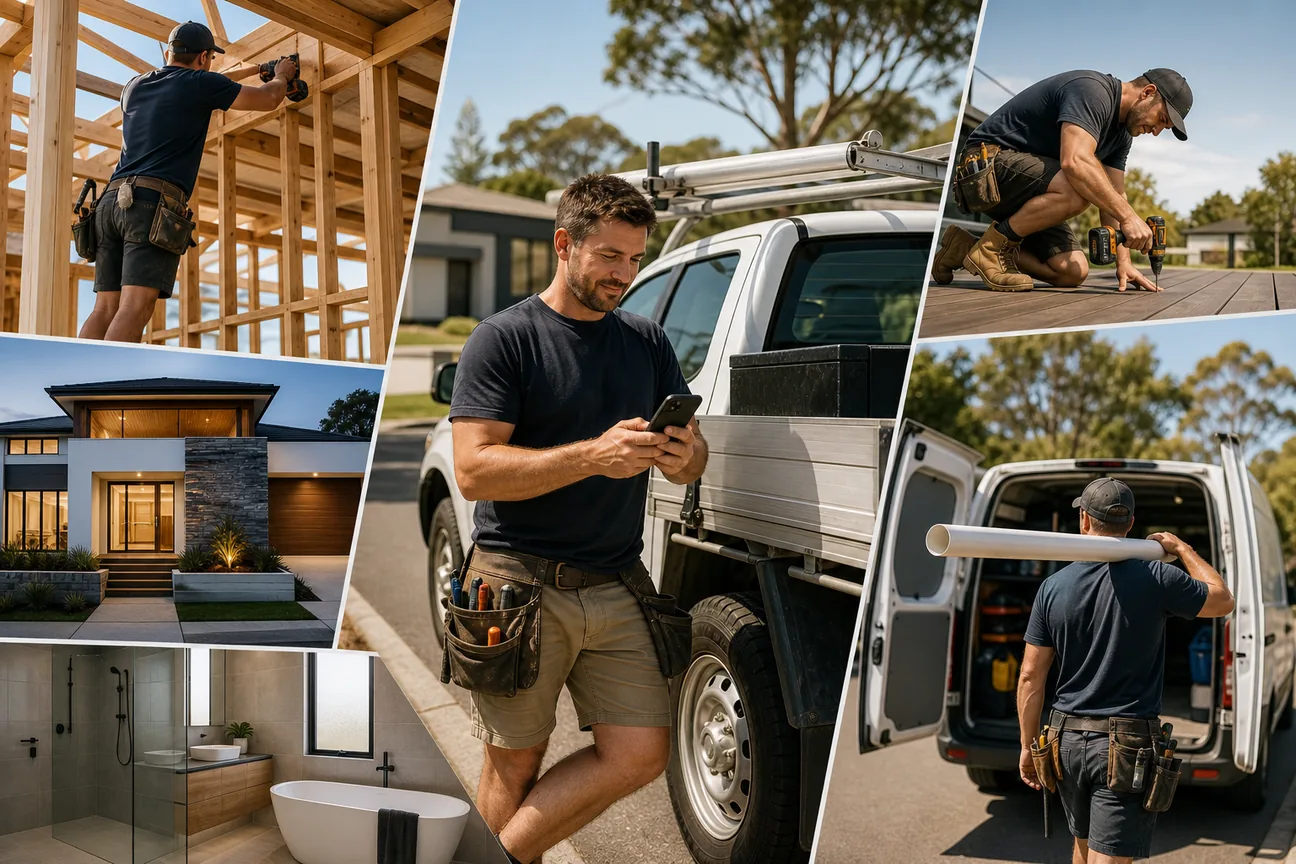
Stock photos of a smiling model in a hard hat tell a customer nothing. Your own photos of finished jobs show that you do this work, at this standard, around here. Phone photos are fine if they are in focus, well lit, and cropped well. Before-and-after shots of the same job are the strongest proof you can show.
Put each photo next to the service it proves, rather than in one large gallery nobody scrolls through. Keep the file sizes down too, or the photos will cancel out the speed you gained in point 3.
7. Reviews where people make up their mind
Customers check reviews before they ring, and they are picky about them. BrightLocal's Local Consumer Review Survey 2026 found that 47% of consumers will not use a business with fewer than 20 reviews, 68% will only use one rated four stars or more, and 74% look for reviews written in the last three months. That survey is of US consumers, so treat the exact numbers as a guide for Australia, but the pattern matches what tradies tell me.
Your website should show your Google rating and a few recent reviews, linked to the real listing so people can check them. Never write reviews yourself or copy them in without the customer's say-so. The fix for too few reviews is asking every customer, every time. If you want to see what too few reviews can cost you in a month, I worked it through for Adelaide tradies.
8. Your licence number and ABN are on it
This one is the law as well as good sense. In South Australia, Consumer and Business Services says a building work contractor is required to publish their name or registered business name and licence number in ads for building work. In New South Wales, the government's page on building trade advertisements says the licensee's name and licence number must be shown in all advertising, and it lists the internet among the media covered. Other states have their own rules, so check with your licensing body.
Put the licence number and ABN in the footer of every page and on the contact page. It also shows a careful customer that you are genuine, which matters once they have read about unlicensed operators in the news.
9. A short quote form that reaches your phone
Some people will not ring. They are at work, it is after hours, or they want to send photos of the problem. Give them a quote form, and keep it short: name, mobile, suburb, what they need, and a way to attach a photo. Every extra field turns a few people away.
Then make sure the enquiry reaches you fast. A form that emails an inbox you only check on Sunday night loses jobs to whoever replies first. Have it send you a text, and reply the same day.
If you use a job management or CRM app, see if it can take enquiries from your website form. This way, new jobs will go to the same place as your quotes and invoices. The Stack Insiders compares six CRM options for service businesses, including Jobber, if you are choosing one.
10. It works with your Google Business Profile
For most local searches, people see your Google Business Profile in the map results before they ever see your website. The two should match: the same business name, phone number, service areas, and hours. Your profile should link to your website, and your website should link back to your profile so people can read the reviews.

Google says, in its Business Profile help, that customers are 2.7 times more likely to consider a business reputable when it has a complete Business Profile. It does not say how it measured that, but it is free, so fill in every field.
What a tradie website does not need
Tradies spend plenty of money on things that do not change whether the phone rings:
- Sliders and video backgrounds. They slow the page down, and most visitors never see past the first slide.
- A dozen near-identical suburb pages. See point 5.
- A chat widget nobody answers. A form that texts you does the same job, and you will actually see it.
- Clever wording. Your vision, our passion tells nobody what you do. Bathroom renovations in the eastern suburbs does.
- Lots of pages for their own sake. Four good pages beat fifteen thin ones. A small tradie site usually needs a home page, a page per main service, an about page, and a contact page.
If you are weighing up what a site like this should cost, I have written a separate guide on what a tradie website costs in Australia, and another on whether you need a website if you are on hipages.
Check your own site in ten minutes
Grab your phone, open your own site as if you were a customer, and go down this list.
| Check | How to test it | Pass if |
|---|---|---|
| First screen | Open the home page and do not scroll | You can see your trade, your area, and a number to tap |
| Phone number | Tap it on three different pages | It dials the right number every time |
| Speed | Run the home page through PageSpeed Insights, mobile | Core Web Vitals show as passed |
| Service pages | Look at the menu | Each main job you want has its own page |
| Service areas | Look for the suburbs you cover | They are named in plain words |
| Photos | Scroll a service page | The photos are your own jobs |
| Reviews | Look for your rating | Shown and linked to your Google listing |
| Licence and ABN | Check the footer | Both are there on every page |
| Quote form | Send yourself a test enquiry | It reaches your phone within a minute |
| Google Business Profile | Compare the details side by side | Name, number, and areas match |
If you fail two or three, a few fixes will probably do. If you fail most of them, it is usually cheaper to start again than to patch an old theme. The style picker shows what a new one could look like.
Questions tradies ask
Do I need a website if I already have a Google Business Profile?
Your profile helps you appear in map results, but it gives you little space to explain your services, show your work or rank for specific jobs. A website lets you do that, and your profile links to it. Most tradies do best with both, kept consistent.
How many pages should a tradie website have?
Enough to cover each main service once, plus a home, about, and contact page. For most sole traders and small teams, that is four to eight pages. Add a page when you have something real to say, such as a new service or an area you now cover.
Can I build my own tradie website with a website builder?
Yes, and plenty of tradies do. The builder is rarely the problem. What often goes wrong is the content: no service pages or service areas, stock photos, and a phone number buried at the bottom. If you build it yourself, use the checklist above.
Does my licence number have to be on my website?
In several states, the licence number has to appear in advertising. SA and NSW both say so in their published guidance, and the NSW page lists the internet among the media covered. The rules differ by state and trade, so check with your own licensing body. Putting it in the footer costs nothing.
How long does a tradie website take to build?
Once the builder has your photos and details, a small site can be live within a week or two. The slow part is usually gathering photos and deciding which jobs to feature, so start collecting job photos now.
Q&A
Question: Which website fixes should a tradie do first if they cannot do everything at once?
Short answer: Start with the fixes that make it easy for a customer to contact you. Show what you do, where you work, and a tap-to-call number on the first screen. Make sure the phone number works on every page, and test that the quote form reaches your phone fast. After that, add your own job photos, recent reviews, licence number, and ABN, then build service pages for the jobs you want more of.
Question: Why is a separate service page better than listing every job on one services page?
Short answer: A separate service page matches how customers search. Someone wanting a switchboard upgrade or bathroom renovations needs specific details about that job. A focused page can explain what is involved and what changes the price, show the right photos and give the customer a clear way to book. It also gives Google a clearer page to rank for that service.
Question: What makes a service area page useful instead of spammy?
Short answer: A useful service area page says something real about that location, such as jobs completed there, how far you travel, nearby suburbs you cover, or service details that matter in that area. A spammy one is usually a near-copy with only the suburb name changed. Name your service areas honestly and avoid dozens of cloned suburb pages.
Question: How can a tradie show proof if they do not have many reviews yet?
Short answer: Use the proof you do have: add your licence number and ABN, show genuine photos of your own work, link to your real Google Business Profile, and ask every customer for a review after the job. Do not write reviews yourself or copy them in without permission. The long-term fix is a steady habit of asking every customer.
Question: Why does mobile speed matter so much for a tradie website?
Short answer: Many customers visit a tradie website on mobile data while dealing with an urgent problem, so a slow page can lose them before they even see your phone number. Speed also matters because Google's page experience guidance includes Core Web Vitals, which measure loading speed and stability. Check the mobile result in PageSpeed Insights first.
Have me check yours
If you would rather not check the list yourself, just tell me what you do and where you work. I will send you a fixed price in writing within 24 hours. I can also let you know if a few fixes will be enough. Get a quote, see what a build and monthly care cost, or call me, Jordan, on 0485 679 116.